

Researchers from Matériaux et Phénomènes Quantiques laboratory have directly observed, for the first time, a reversible phase transition between amorphous and crystalline states in ultra-small gold nanoparticles. Their findings reveal that the atomic structure of gold clusters is dictated by their size, opening new perspectives for the rational design of catalysts and functional nanomaterials.
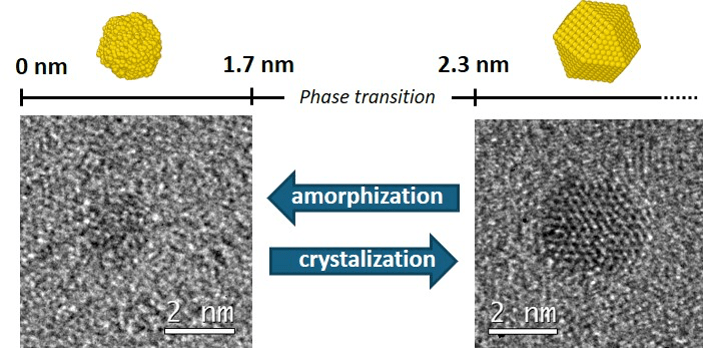
At the nanoscale, gold behaves in surprising ways. While bulk gold is invariably crystalline, particles only a few nanometres in diameter can adopt entirely different atomic structures, dramatically affecting their physical and chemical properties. Understanding when and why these structural changes occur has remained one of the major challenges in nanoscience.
In a study, researchers from Université Paris Cité and CNRS, in collaboration with ONERA, CEREGE, Michelin and IFP Energies Nouvelles, have now uncovered the existence of a well-defined size threshold governing the atomic structure of ligand-free gold nanoparticles.
To achieve this, the team combined aberration-corrected high-resolution transmission electron microscopy with graphene liquid cells, allowing them to observe individual nanoparticles evolving in water with atomic resolution. Rather than studying static particles, the researchers followed their growth and dissolution in real time through the slow atomic exchange process known as Ostwald ripening.
Their observations revealed a striking behavior. Gold nanoparticles smaller than 1.7 nm are always amorphous, whereas particles larger than 2.3 nm are invariably crystalline. Between these two limits, however, nanoparticles repeatedly switch from one state to the other as they gain or lose atoms.
This is the first direct observation of a reversible amorphous–crystalline phase transition in ultra-small gold colloids. The fact that the transition occurs both during growth and dissolution demonstrates that it reflects a genuine thermodynamic equilibrium rather than a transient phenomenon associated with kinetic effects. This conclusion is confirmed by atomistic Monte Carlo simulations within a tight-binding framework showing that amorphous and crystalline structures possess nearly identical stability at the smallest sizes, while crystalline nanoparticles become progressively more favourable as their diameter increases.
These fundamental results bring crucial information for the synthesis and the applications of gold nanoparticles. Since the atomic structure of gold strongly influences its catalytic and optical properties, identifying the critical size at which crystallization occurs could help explain the remarkable size-dependent performances reported for gold nanocatalysts. More generally, these results provide valuable guidelines for controlling nanoparticle crystallization during synthesis, an essential step for engineering nanomaterials with controlled shape.
By directly capturing these reversible structural transformations in liquid at atomic resolution, the study demonstrates the unique capabilities of in situ electron microscopy for revealing dynamic phenomena that remain inaccessible to conventional characterization techniques.
Reference :
Size-dependent amorphous-crystalline phase transitions in ultrasmall gold colloids
V. Ramnarain, M. Moreaud, R. Moreau, A. Gelabert, A. Moncomble, R. Gatti, G. Wang, C. Ricolleau, J. Nelayah, N. O. Peña, A. Gelabert, H. Amara and D. Alloyeau
J. Mater. Chem. A 14 (30): 19569–19575 (2026)
Contact : Damien Alloyeau
À lire aussi
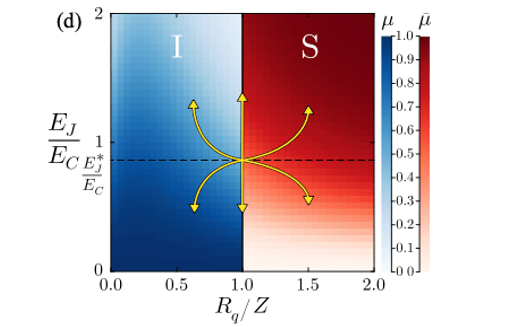
Exact low-energy duality in superconducting quantum circuits
The THEORIE team, in collaboration with Michel H. Devoret, has published a theoretical study in Physical Review Letters demonstrating an exact low-energy duality in circuits where a Josephson junction is coupled to a multi-mode environment. These systems exhibit a...

Seminars
2025-2026 MPQ general seminar series organized by Niloufar Nilforoushan and Valentin Cambier Prof. Junichiro Kono — Rice University, Houston, Texas 77005, U.S.A.Cavity-Dressed Quantum MatterApr. 10, 2026 at 2:00 pm — Pierre-Gilles de Gennes Room (S73A) Dr. Yannis...

Exhibition – Matériaux et phénomènes illustrés
General public exhibition, free access. At the MPQ laboratory, electronic and photonic chips are designed and manufactured for use in both fundamental research and industrial applications, such as quantum telecommunications and high-precision mechanical sensors.The...
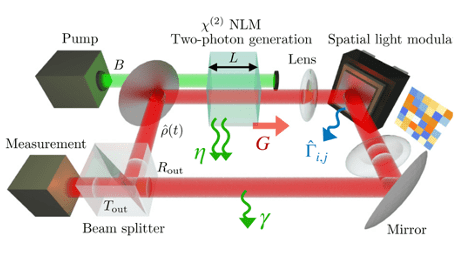
Emergent Equilibrium in All-Optical Single Quantum-Trajectory Ising Machines
A collaboration between the Theory group at MPQ, CREF Rome, and Sapienza University of Rome has shown that multimode all-optical systems driven by two-photon processes can reach thermal equilibrium at the level of single quantum trajectories. The study is published in...