

In a recent study, researchers from the QITE team at MPQ and from the department of Mathematics of ENS have refined the mathematical framework needed to coherently describe quantum states involving multiple photons.
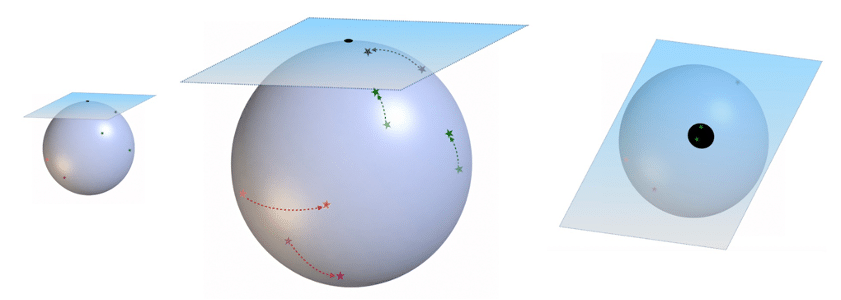
(Left) When the phase reference is explicitly included as a parameter in the description of bosonic states, these states can be uniquely represented by a distribution of stars on the surface of a sphere. (Center) As the radius of the sphere increases—which corresponds to an increase in the number of photons—the stars move continuously along the spherical surface in proportion to the total number of photons. A plane tangent to a point (the phase reference) can also be defined. (Right) Top view of the sphere. When there are a large number of particles, the field is usually described by a finite region of the surface of a sphere with a large radius. However, not all stars contributing to the complete spherical representation can be contained within this region.
Light can exhibit quantum properties that have no equivalent in our everyday experience. These “multiphoton” states of light are being studied by physicists, who are attempting to harness their unique characteristics in quantum technologies, particularly quantum computers and ultra-high-precision sensors. However, these non-classical properties have remained poorly understood until now, given their intrinsic complexity.
In a recent study, researchers from the MPQ and the department of Mathematics at ENS Paris have shown that these properties can be better described using a new geometric representation. Instead of describing light in the conventional way, they consider its phase reference—usually assumed to be a number, embodying the invariance of electromagnetism under time translation—to be an integral part of the quantum system. This conceptually simple modification transforms the standard mathematical description—defined on a plane—into a representation on the surface of a sphere. On this sphere, specific points appear, which the researchers have called “stars.” These points play a very important role in describing multiphoton states, as they reveal the extremely complex way in which photons are linked to one another through quantum entanglement, and how the nonclassical properties of light are directly related to this entanglement.
The flat representation typically used in quantum optics thus appears as a local approximation of this sphere, just as the Earth’s surface appears flat to us on a human scale. In this approximation, only a small portion of the “stars” is visible, while the rest remain hidden. These results reveal a richer structure than previously thought and offer a unified view of two fundamental features of quantum physics: the nonclassical states of light and the ability of similar particles to become entangled. They have been published in Physical Review Letters.
Reference:
Contacts: Pérola Milman
À lire aussi
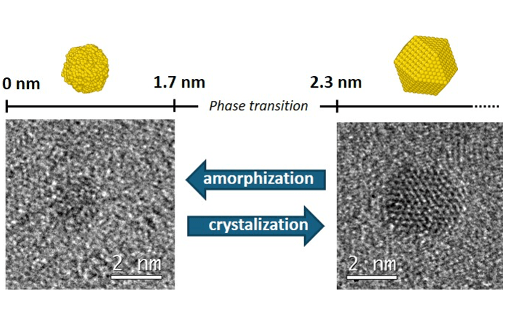
Watching gold switch between order and disorder
Researchers from Matériaux et Phénomènes Quantiques laboratory have directly observed, for the first time, a reversible phase transition between amorphous and crystalline states in ultra-small gold nanoparticles. Their findings reveal that the atomic structure of gold...
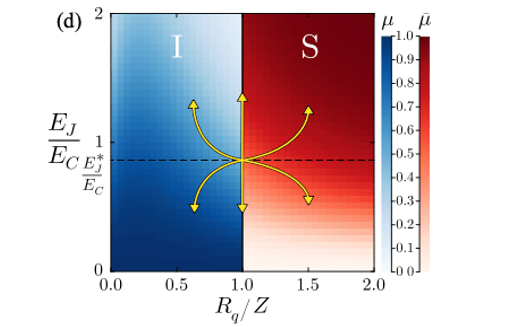
Exact low-energy duality in superconducting quantum circuits
The THEORIE team, in collaboration with Michel H. Devoret, has published a theoretical study in Physical Review Letters demonstrating an exact low-energy duality in circuits where a Josephson junction is coupled to a multi-mode environment. These systems exhibit a...

Seminars
2025-2026 MPQ general seminar series organized by Niloufar Nilforoushan and Valentin Cambier Prof. Junichiro Kono — Rice University, Houston, Texas 77005, U.S.A.Cavity-Dressed Quantum MatterApr. 10, 2026 at 2:00 pm — Pierre-Gilles de Gennes Room (S73A) Dr. Yannis...

Exhibition – Matériaux et phénomènes illustrés
General public exhibition, free access. At the MPQ laboratory, electronic and photonic chips are designed and manufactured for use in both fundamental research and industrial applications, such as quantum telecommunications and high-precision mechanical sensors.The...