

High-dimensional entangled states of light provide novel possibilities for quantum information, from fundamental tests of quantum mechanics to enhanced computation and communication protocols. In this context, the frequency degree of freedom combines the assets of robustness to propagation and easy handling with standard telecommunication components. Parallelly, the implementation of these concepts on functional and scalable devices is another major challenge of quantum technologies.
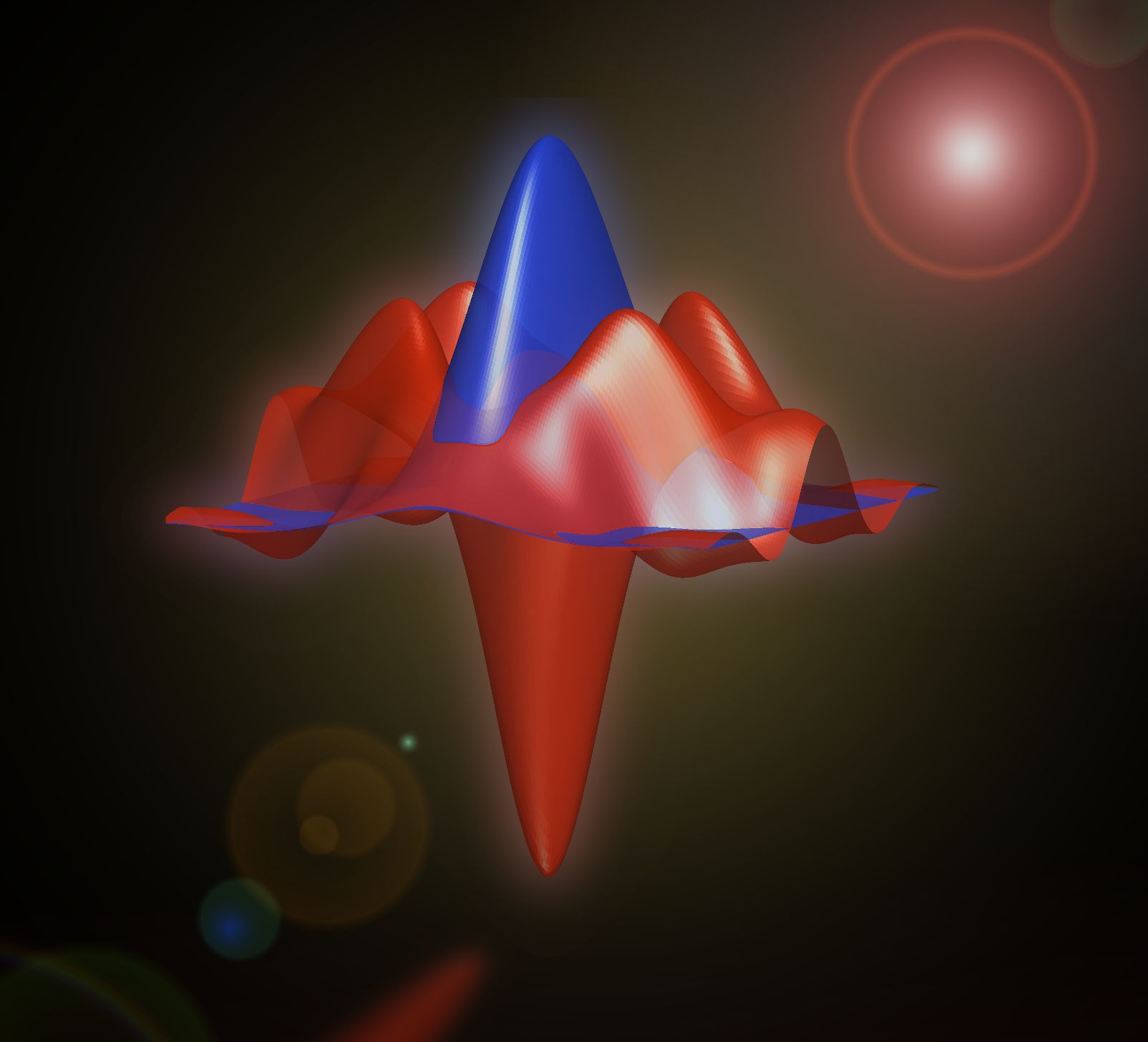
Wigner function (artistic view) of entangled photons exhibiting either a fermionic (red) or bosonic (blue) behavior, generated by a semiconductor chip.
The QITe team of Laboratory MPQ, in collaboration with the Centre for Nanoscience and Nanotechnologies, has addressed this double challenge by demonstrating two novel techniques for generating and manipulating frequency-entangled photon pairs using miniaturized semiconductor chips (AlGaAs).
The first method, published in npj Quantum Information, uses a nonlinear waveguide to generate two-photon frequency combs over a wide spectral range, and to control their symmetry by simply adjusting the frequency of the pump beam and introducing a time delay between the photons of each pair.
The second method, published in Optica, is based on a semiconductor microcavity illuminated by a transverse laser beam. By controlling the spatial profile of this pump beam, the correlations and the symmetry of the quantum state can be engineered, so that the produced photons behave either as bosons or fermions.
These results pave the way for the realization of complex protocols in an integrated manner and for the out-of-the-lab deployment of quantum technologies based on high-dimensional quantum states, which could be used in future quantum networks.
Link to the coverage article on the INP website
Contact:
M. Amanti, F. Baboux, S. Ducci
References:
Generation and symmetry control of quantum frequency combs, G. Maltese, M. Amanti, F. Appas, G. Sinnl, A. Lemaître, P. Milman, F. Baboux, S. Ducci, npj Quantum Information 6, 13 (2020)
Engineering two-photon wavefunction and exchange statistics in a semiconductor chip, S. Francesconi, F. Baboux, A. Raymond, N. Fabre, G. Boucher, A. Lemaître, P. Milman, M. Amanti, S. Ducci, Optica 7, 316 (2020)
À lire aussi

Florent Baboux elected IUF Junior Member
Florent Baboux, associate professor at MPQ laboratory, has been elected a Junior Member of the Institut Universitaire de France (IUF) under the Fundamental chair. Congratulations! His research aims to use light to explore and control quantum phenomena that remain...
The sky of quantum light is not flat
In a recent study, researchers from the QITE team at MPQ and from the department of Mathematics of ENS have refined the mathematical framework needed to coherently describe quantum states involving multiple photons. (Left) When the phase reference is explicitly...
An optomechanical disk in its fundamental state of motion
The motion of a mesoscopic mechanical resonator can exhibit quantum behavior when cooled to very low temperatures. In particular, it can reach its ground state and cease to vibrate. Using light as a probe, the LIME team at the MPQ laboratory demonstrated that...
Watching gold switch between order and disorder
Researchers from Matériaux et Phénomènes Quantiques laboratory have directly observed, for the first time, a reversible phase transition between amorphous and crystalline states in ultra-small gold nanoparticles. Their findings reveal that the atomic structure of gold...