

Researchers from the DON team have demonstrated and analyzed the generation of high-purity second-harmonic vortices with dielectric metasurfaces. These results are published in Light: Science and Applications.
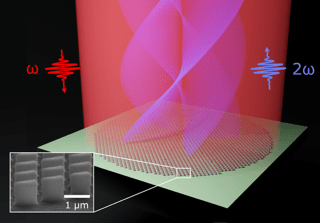
Vortex beams are currently drawing a great deal of interest, from fundamental research to several promising applications. While their generation in bulky optical devices limits their use in integrated complex systems, metasurfaces have recently proven successful in creating optical vortices, especially in the linear regime. In the nonlinear domain, of strategic importance for the future of classical and quantum information, to date orbital angular momentum has only been created in qualitative ways, without discussing discrepancies between design and experimental results. Here, we demonstrate and analyze the generation of high-purity second harmonic (SH) optical vortices via dielectric meta-holograms. Through full-wave simulations and a proper fabrication protocol, we achieve efficient frequency doubling of an unstructured pump beam into SH vortices with topological charges from 1 to 10. Interferometric and modal-purity measurements confirm the generation of high-quality SH vortices with minimal deviations from the intended design thanks to a quasi-local control over the SH phase. Through systematic comparisons between experimental data and semi-analytical calculations, we also provide a clear insight into the occurrence of ghost vortices in the metasurface-generated harmonic beams, highlighting the importance of simple designs that can be readily transposed into fabricated devices with high fidelity. These findings underscore the potential of nonlinear dielectric metasurfaces for versatile structured-light generation and manipulation, paving the way for future developments in integrated photonic systems
Reference :
Unravelling the nonlinear generation of designer vortices with dielectric metasurfaces
L. Coudrat, G. Boulliard, J.M. Gérard, A. Lemaître, A. Degiron, G. Leo
À lire aussi
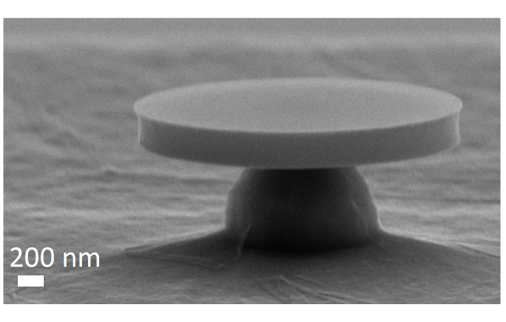
An optomechanical disk in its fundamental state of motion
The motion of a mesoscopic mechanical resonator can exhibit quantum behavior when cooled to very low temperatures. In particular, it can reach its ground state and cease to vibrate. Using light as a probe, the LIME team at the MPQ laboratory demonstrated that...
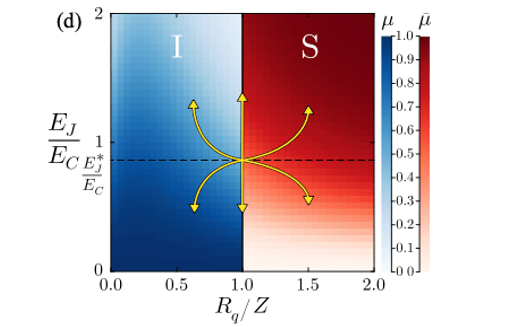
Exact low-energy duality in superconducting quantum circuits
The THEORIE team, in collaboration with Michel H. Devoret, has published a theoretical study in Physical Review Letters demonstrating an exact low-energy duality in circuits where a Josephson junction is coupled to a multi-mode environment. These systems exhibit a...
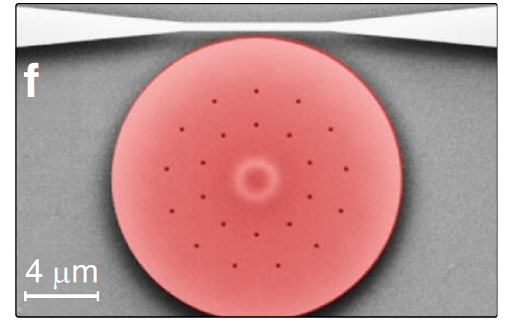
Multiphysics optomechanical sensing of a liquid on the micron scale
The LIME team at MPQ laboratory, in collaboration with CEA LETI in Grenoble, has published an article in Microsystems & Nanoengineering presenting an optomechanical platform for characterizing the rheological, optical, and thermal properties of fluids at the...
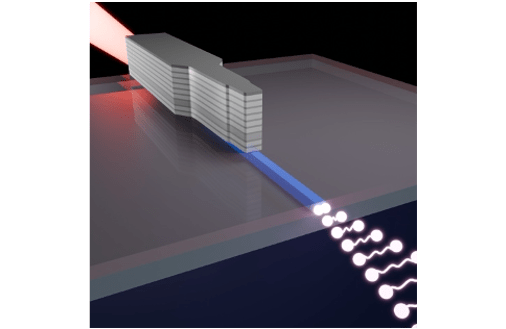
Biphoton state generation and engineering with bright hybrid III–V/silicon photonic devices
The QITE team at the MPQ Laboratory, in collaboration with STMicroelectronics, C2N, and INPHYNI, published a paper in Optica Quantum on the generation and engineering of two-photon states using III-V/SOI hybrid devices. Artist’s sketch of...