

Laboratoire: MPQ (Matériaux et Phénomènes Quantiques), Université Paris Cité & CNRS
Adresse: Bâtiment Condorcet – 10 Rue A. Domon et L. Duquet – 75013 Paris
Directeur de stage/thèse: Amandine Bellec
Tel: 0157276290
e-mail: amandine.bellec@u-paris.fr
Scientific project:
Chiral molecules are present in the form of two non-superimposable enantiomers due to the absence of inversion center (figure 1). They then offer the unique possibility of being able to create spin selectivity at the interface with a metal. This effect, known as the CISS (chiral induced spin-selectivity) effect, was demonstrated in the early 2000s on monolayers of lysine molecules, long carbon chains, adsorbed on Au [1]. But, the origin of this effect is still widely debated [2]. Experimentally, the CISS effect brings together all the phenomena for which the chirality of molecular species influences the spin selectivity of various electronic processes, whether for transmitted electrons [3,4], for transport measurements [5] or even during chemical reactions. To illustrate this last point, studies have been able to demonstrate enantio-selectivity during the adsorption of chiral molecules on magnetic substrates: depending on the orientation of the magnetization, an enantiomer is preferentially adsorbed [6].
In this context, the internship will focus on the interfaces between chiral molecules and metallic or ferromagnetic substrates in order to understand their properties. For this, measurements by scanning tunneling microscopy (STM) will be carried out. For the structural properties, it will be important to understand how chiral molecules adsorb on different metallic substrates. Furthermore, tunneling spectroscopy will provide access to the electronic properties of molecules and it will then be interesting to understand how the CISS effect translates into transport through molecular orbitals, before testing the spin selectivity.
[1] Ray et al., Science 283, 814-816 (1999).
[2] Evers el al., Advanced Materials, 2106629 (2022).
[3] Göhler et al., Science 331, 894-897 (2011).
[4] Kettner et al., The Journal of Physical Chemistry Letters 9, 2025-2030 (2018).
[5] Rodríguez et al., J. Am. Chem. Soc. 144, 24 (2022).
[6] Banerjee-Ghosh et al., Science 360, 1331-1334 (2018).
Methods and techniques: Scanning tunneling microscopy
Possibility to go on with a PhD: YES
Envisaged fellowship: Doctoral School
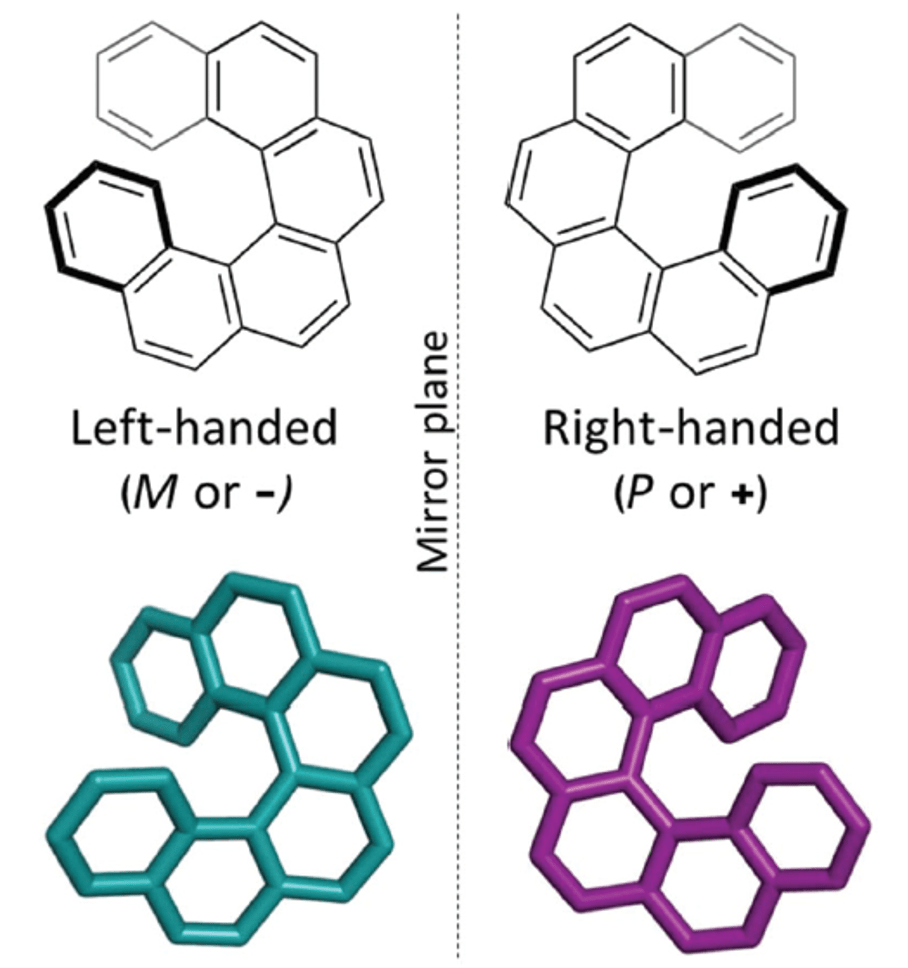
Figure 1 : Scheme of [6]-helicene molecules
À lire aussi
An optomechanical disk in its fundamental state of motion
The motion of a mesoscopic mechanical resonator can exhibit quantum behavior when cooled to very low temperatures. In particular, it can reach its ground state and cease to vibrate. Using light as a probe, the LIME team at the MPQ laboratory demonstrated that...
Watching gold switch between order and disorder
Researchers from Matériaux et Phénomènes Quantiques laboratory have directly observed, for the first time, a reversible phase transition between amorphous and crystalline states in ultra-small gold nanoparticles. Their findings reveal that the atomic structure of gold...
Exact low-energy duality in superconducting quantum circuits
The THEORIE team, in collaboration with Michel H. Devoret, has published a theoretical study in Physical Review Letters demonstrating an exact low-energy duality in circuits where a Josephson junction is coupled to a multi-mode environment. These systems exhibit a...
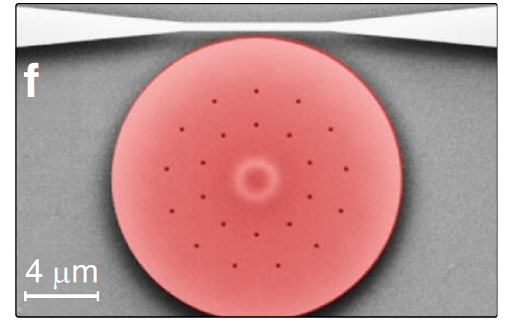
Multiphysics optomechanical sensing of a liquid on the micron scale
The LIME team at MPQ laboratory, in collaboration with CEA LETI in Grenoble, has published an article in Microsystems & Nanoengineering presenting an optomechanical platform for characterizing the rheological, optical, and thermal properties of fluids at the...