



A Metamaterial-based technology to create Electricity from Light (AMELI)
The ERC POC AMELI aims to convert light into electricity using metamaterials, i.e. artificial materials whose properties are mainly dictated by their internal geometric parameters. This new approach is based on controlled effects of the temperature of the electrons created by illumination of the structures. A first proof of concept in the field of photovoltaics and/or photodetection will be presented at the end of the project.
Also worth reading
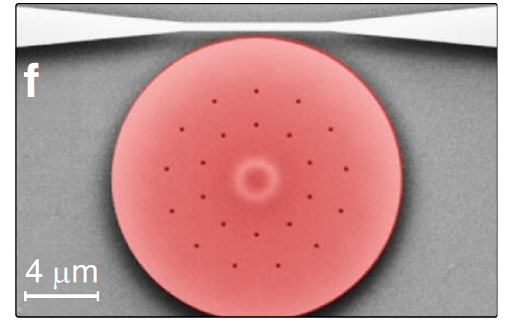
Multiphysics optomechanical sensing of a liquid on the micron scale
The LIME team at MPQ laboratory, in collaboration with CEA LETI in Grenoble, has published an article in Microsystems & Nanoengineering presenting an optomechanical platform for characterizing the rheological, optical, and thermal properties of fluids at the...
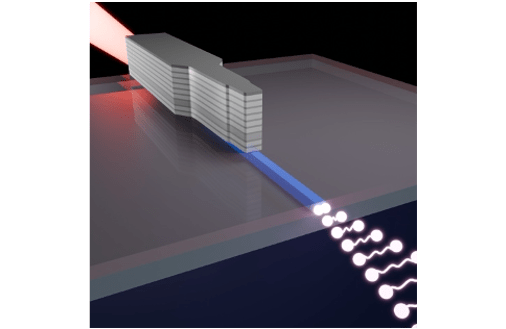
Biphoton state generation and engineering with bright hybrid III–V/silicon photonic devices
The QITE team at the MPQ Laboratory, in collaboration with STMicroelectronics, C2N, and INPHYNI, published a paper in Optica Quantum on the generation and engineering of two-photon states using III-V/SOI hybrid devices. Artist’s sketch of...

TUPHO, for large-scale production of integrated photonic circuits
The TUPHO project is an initiative that aims to bridge the gap between upstream innovation and large-scale production in the integrated photonic circuits (PICs) industry. It is led by Hamidreza Neshasteh and Ivan Favero, members of the Light and Mechanics team at MPQ...

On-Chip Ferromagnetic Resonance for van der Waals Heterostructures: Anisotropy and Damping of Cobalt Interfaced with Exfoliated 2D Materials
A collaboration between the technical hub, the clean room platform and the TELEM group at MPQ laboratory has developped a new experiment demonstrating that standard broadband ferromagnetic resonance can still be effective to probe the magnetization dynamics of “thin...