

The motion of a mesoscopic mechanical resonator can exhibit quantum behavior when cooled to very low temperatures. In particular, it can reach its ground state and cease to vibrate. Using light as a probe, the LIME team at the MPQ laboratory demonstrated that optomechanical disks can reach this regime. This study, published in Physical Review Letters, is an important step toward manipulating the quantum vibrations of these devices.
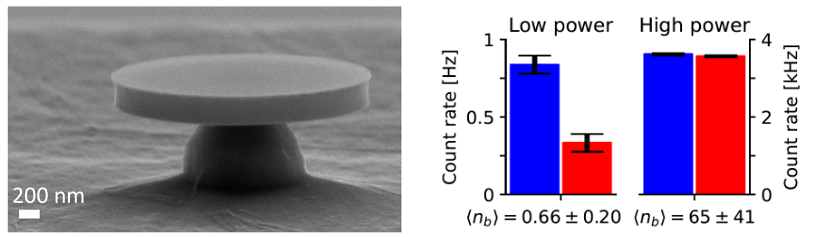
(Left) Scanning electron microscope image of an optomechanical disk. (Right) Thermometry based on the counting of scattered photons in the optomechanical sidebands (Stokes in blue, anti-Stokes in red). At low optical power, the disk reaches an average occupation of less than 1 phonon.
At room temperature, the atoms constituting an object oscillate constantly due to thermal motion. To reveal the quantum properties of a mechanical device, this thermal motion must be eliminated through cooling. One way to determine the effective temperature of the device is then to couple its motion to light and measure the latter. This is the approach taken by the LIME team to demonstrate the cooling of an optomechanical disk very close to its ground state of motion, the “phonon vacuum” (the quantum of vibration), in a paper published in Physical Review Letters.
The disks used are micrometer-sized objects made of a semiconductor material (gallium arsenide) that vibrate at high frequencies (GHz). Over the years, they have enabled numerous advances as sensors – in magnetometry, high-frequency fluid rheology, and the measurement of the mass of individual nanoscale objects – but only in the classical regime. To reach the quantum regime, the device was cooled in a dilution refrigerator down to a temperature of approximately 10 millikelvin. Its vibrational state was then probed using thermometry by photon-counting in the optomechanical sidebands: two laser beams are positioned alternately on either side of the optical resonance at a spectral distance of one vibrational quantum, allowing for the measurement of phonon creation and annihilation processes. When the resonator reaches its ground state, the annihilation of a phonon becomes extremely unlikely, since there is no vibration left to suppress. Comparing the occurrence rates of these two processes thus provides a direct measurement of the quantum occupancy of the mechanical mode. The measurements reveal an average occupancy of 0.66 ± 0.2 phonons in the resonator, corresponding to a probability of approximately 60% that the resonator is in its ground state. This recent work shows that a regime in which it is possible to manipulate, count, add, and subtract the quantum vibrations of optomechanical disks is now within reach.
Reference:
Optomechanical disk resonator in the quantum ground state of motion
A. Barbero, S. Pautrel, B. Evrard, J. Bon, R. Dezert, M. Morassi, A. Lemaître, A. Borne, and I. Favero
Contacts: Adrien Borne, Ivan Favero
À lire aussi
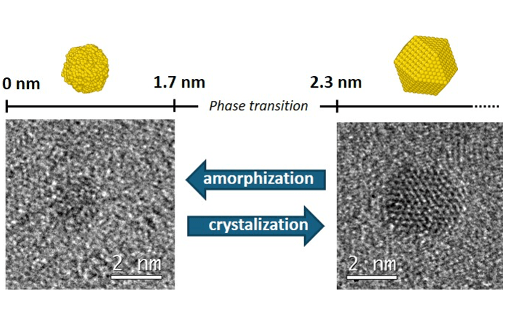
Watching gold switch between order and disorder
Researchers from Matériaux et Phénomènes Quantiques laboratory have directly observed, for the first time, a reversible phase transition between amorphous and crystalline states in ultra-small gold nanoparticles. Their findings reveal that the atomic structure of gold...
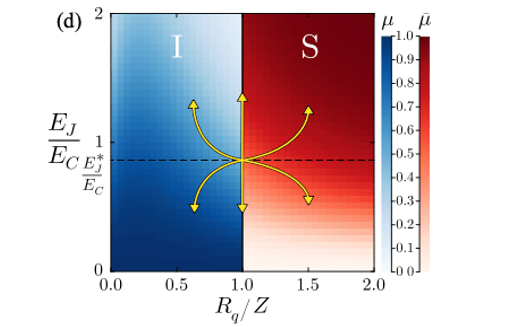
Exact low-energy duality in superconducting quantum circuits
The THEORIE team, in collaboration with Michel H. Devoret, has published a theoretical study in Physical Review Letters demonstrating an exact low-energy duality in circuits where a Josephson junction is coupled to a multi-mode environment. These systems exhibit a...

Seminars
2025-2026 MPQ general seminar series organized by Niloufar Nilforoushan and Valentin Cambier Prof. Junichiro Kono — Rice University, Houston, Texas 77005, U.S.A.Cavity-Dressed Quantum MatterApr. 10, 2026 at 2:00 pm — Pierre-Gilles de Gennes Room (S73A) Dr. Yannis...

Exhibition – Matériaux et phénomènes illustrés
General public exhibition, free access. At the MPQ laboratory, electronic and photonic chips are designed and manufactured for use in both fundamental research and industrial applications, such as quantum telecommunications and high-precision mechanical sensors.The...