

A collaboration between the Theory group at MPQ, CREF Rome, and Sapienza University of Rome has shown that multimode all-optical systems driven by two-photon processes can reach thermal equilibrium at the level of single quantum trajectories. The study is published in Physical Review Letters.
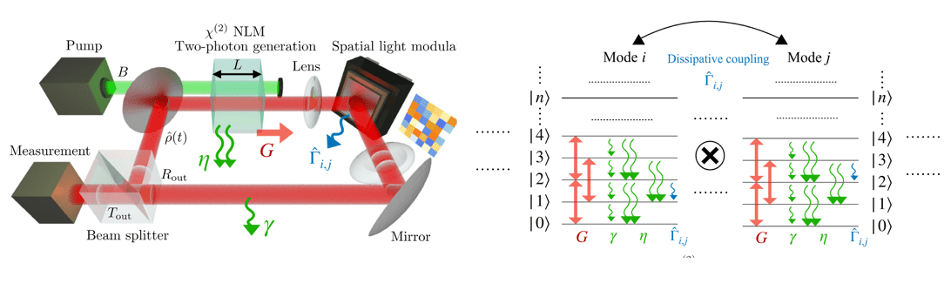
(Right) Example of an optical setup implementing this model using nonlinear crystals and spatial light modulators.
Using a Gaussian quantum trajectory approach, the researchers demonstrate that the photon statistics follow a Boltzmann distribution governed by an effective Ising model. This emergent thermal behavior arises from engineered dissipative couplings between modes and is tunable via the optical drive.
Thanks to ultrafast timescales, these systems could serve as optical Boltzmann samplers for solving complex optimization problems, with applications in machine learning and artificial intelligence.
Reference:
Contact: Cristiano Ciuti
À lire aussi
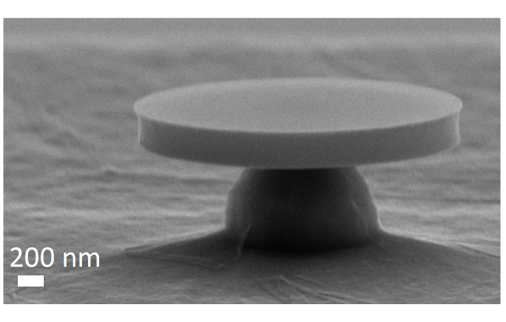
An optomechanical disk in its fundamental state of motion
The motion of a mesoscopic mechanical resonator can exhibit quantum behavior when cooled to very low temperatures. In particular, it can reach its ground state and cease to vibrate. Using light as a probe, the LIME team at the MPQ laboratory demonstrated that...
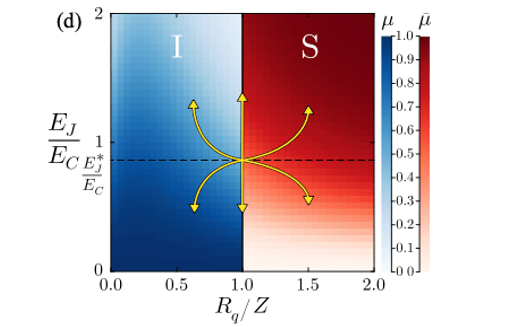
Exact low-energy duality in superconducting quantum circuits
The THEORIE team, in collaboration with Michel H. Devoret, has published a theoretical study in Physical Review Letters demonstrating an exact low-energy duality in circuits where a Josephson junction is coupled to a multi-mode environment. These systems exhibit a...
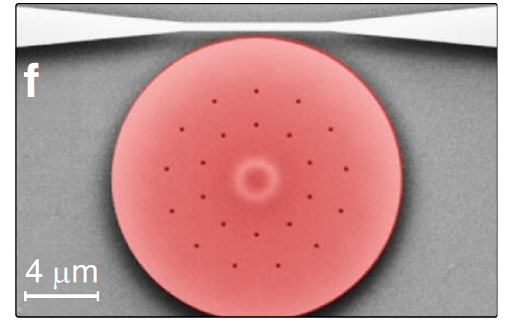
Multiphysics optomechanical sensing of a liquid on the micron scale
The LIME team at MPQ laboratory, in collaboration with CEA LETI in Grenoble, has published an article in Microsystems & Nanoengineering presenting an optomechanical platform for characterizing the rheological, optical, and thermal properties of fluids at the...
Biphoton state generation and engineering with bright hybrid III–V/silicon photonic devices
The QITE team at the MPQ Laboratory, in collaboration with STMicroelectronics, C2N, and INPHYNI, published a paper in Optica Quantum on the generation and engineering of two-photon states using III-V/SOI hybrid devices. Artist’s sketch of...