

Join the team
Postdoctoral position : quantum states of motion of mechanical resonators - superposition and entanglement
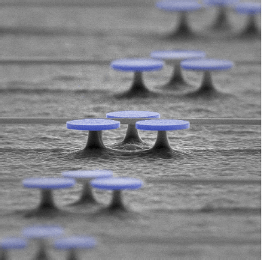
The motion of massive, mesoscopic-scale mechanical resonators can behave quantum mechanically when cooled down to ultra-low temperatures. The exploration of such systems in the quantum regime has both fundamental and practical interests: as a test of quantum mechanics in systems beyond the few-particle ensembles, and its interplay with gravitation; or as a light-matter interface for the development of quantum communication networks, for storing and transducing quantum information.
A mechanical resonator, such as the micrometer-sized disks fabricated in our team (see picture), also confines optical modes that strongly interact with the motion. Therefore, light provides a means to shape the quantum state of motion of such an object when prepared close to its ground state (the ‘phonon vacuum’), by adding or removing phonons one by one. This project aims to do so. Light also probes the obtained states, which will then be characterized through optical tomographic reconstruction.
This project also seeks to achieve multipartite quantum control, entanglement and superposition, in systems composed of several of these optomechanical resonators, either evanescently coupled or arranged in an interferometric configuration. It will target in particular the generation of maximally-entangled GHZ states, of importance in quantum computing protocols, or N00N states, of interest for sensing with sub-standard quantum limit sensitivity, and offering the possibility to explore the concept of nonlocal influence in quantum mechanics.
Methods and techniques: Quantum optomechanics, single-photon counting, quantum state tomography, low temperatures.
References:
I. Favero and K. Karrai, Nat. Phot. 3, 201 (2009); M. Aspelmeyer, T. Kippenberg and F. Marquardt, Rev. Mod. Phys. 86, 1391 (2014)
S. Barzanjeh, Nat. Phys. 10, 1038 (2021)
M.R. Vanner, M. Aspelmeyer and M.S. Kim, PRL 110, 010504 (2013); M.R. Vanner, I. Pikovski, and M.S. Kim, Ann. Phys. 527 (2015)
A. Barbero, S. Pautrel, …, A. Borne, I. Favero (2026)
Contacts: Adrien Borne, Ivan Favero
Postdoctoral position: Quantum Microwave-Optics Mechanical Interface
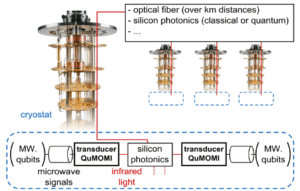
Transducers in a quantum information network, linking microwave qubits nodes and silicon photonics
The development of quantum information technologies requires the interconnection of different quantum systems having specific tasks (processing, memory), such as microwave qubits platforms. Photons in the near-infrared allow for such efficient transfer of quantum information, preserving the non-classical state over long distances. The conversion of quantum information between microwave photons and optical photons is therefore a key step that this project aims to achieve.
The objective of this project is therefore to design a device to demonstrate the conversion of classical and then quantum signals between these two spectral domains. This on-chip converter will consist of a superconducting microwave resonator and an optical resonator, both interacting with a mechanical mode that will mediate the conversion. With these converters, we will then aim to generate entanglement between distant microwave qubits.
This project will be carried out in close collaboration with our partners in Grenoble: the Néel Institute, an expert in superconducting quantum circuits and electromechanics, and CEA Leti, one of Europe’s leading technological research organizations.
Methods and techniques: optomechanics, quantum interconnects, numerical simulations, nanofabrication, low temperatures.
Contacts: Ivan Favero, Adrien Borne
À lire aussi
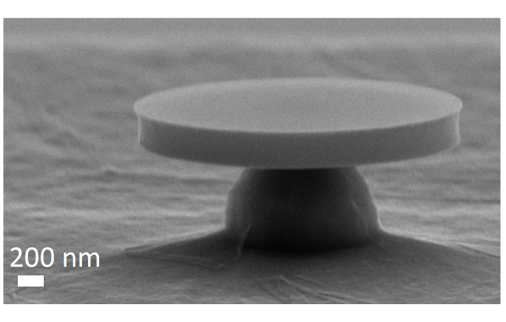
An optomechanical disk in its fundamental state of motion
The motion of a mesoscopic mechanical resonator can exhibit quantum behavior when cooled to very low temperatures. In particular, it can reach its ground state and cease to vibrate. Using light as a probe, the LIME team at the MPQ laboratory demonstrated that...
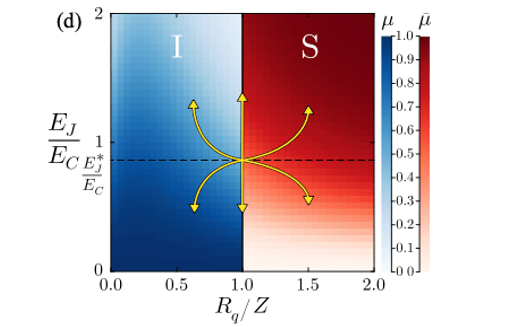
Exact low-energy duality in superconducting quantum circuits
The THEORIE team, in collaboration with Michel H. Devoret, has published a theoretical study in Physical Review Letters demonstrating an exact low-energy duality in circuits where a Josephson junction is coupled to a multi-mode environment. These systems exhibit a...
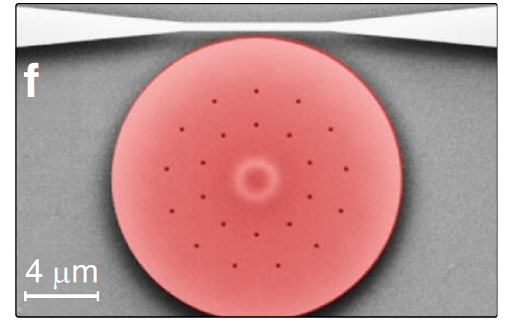
Multiphysics optomechanical sensing of a liquid on the micron scale
The LIME team at MPQ laboratory, in collaboration with CEA LETI in Grenoble, has published an article in Microsystems & Nanoengineering presenting an optomechanical platform for characterizing the rheological, optical, and thermal properties of fluids at the...
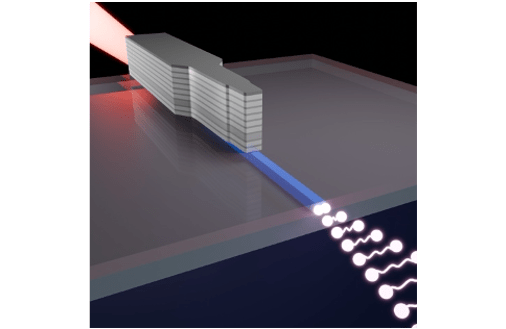
Biphoton state generation and engineering with bright hybrid III–V/silicon photonic devices
The QITE team at the MPQ Laboratory, in collaboration with STMicroelectronics, C2N, and INPHYNI, published a paper in Optica Quantum on the generation and engineering of two-photon states using III-V/SOI hybrid devices. Artist’s sketch of...