

Laboratoire: MPQ (Matériaux et Phénomènes Quantiques), Université Paris Cité & CNRS
Adresse: Bâtiment Condorcet – 10 Rue A. Domon et L. Duquet – 75013 Paris
Directeur de stage/thèse: Clément Barraud
Tel: 0627065271
e-mail: clement.barraud@u-paris.fr
Scientific project:
For this experimental project, we would like to investigate the magnetotransport properties of hybrid ferromagnetic metal/graphene/molecules/ferromagnetic metal spintronic devices. After injection and propagation into the organic film, the spin polarized current will then be detected thanks to magnetoresistive effects at the second electrode. The amplitude of the magnetoresistance and its variation with respect to the energy give precious information to understand the device’s physics. The parameters of interests are the spin injection efficiency, the spin transport properties of the organic film and the efficiency of the detection method. We will thus play with different devices configurations and materials to investigate the spin response of the device and to determine the critical parameters for an efficient spintronics device. In particular, we will investigate quantum interference effects given by the cross- conjugation of certain molecules like anthraquinone [5].
We are looking for a motivated student interested in physics to pursue this research activity. The intern will be in charge of the nanofabrication, the characterization and the measurements of the devices. Ongoing active collaborations with a chemistry group at ITODYS and a physics team at UMPhy CNRS/Thales.
[1] Fert, A. Nobel Lecture: Origin, development, and future of spintronics. Rev. Mod. Phys. 80, 1517–1530 (2008)
[2] Sanvito, S. & Rocha, A. R. Molecular-Spintronics : the art of driving spin through molecules. J. Comput. Theor. Nanosci. 3, 624 –642 (2006).
[3] Bajaj, A., Khurana, R. & Ali, M. E. Quantum interference and spin filtering effects in photo-responsive single molecule devices. J. Mater. Chem. C 9, 11242–11251 (2021).
[4] Barraud, C. et al. Unravelling the role of the interface for spin injection into organic semiconductors. Nat. Phys. 6, 615–620 (2010).
[5] Rabache, V. et al. Direct observation of large quantum interference effect in anthraquinone solid-state junctions. J. Am. Chem. Soc. 135, 10218–21 (2013).
Methods and techniques: micro and nanofabrication in clean-room environment (e-beam lithography, thin film deposition, etching, plasma surface treatment…) structural characterizations by atomic force microscope, electrical transport and magnetotransport measurements from 1K to 350K
Possibility to go on with a PhD: YES
Envisaged fellowship: EDPIF
À lire aussi

Florent Baboux nommé Membre Junior de l’IUF
Toutes nos félicitations à Florent Baboux pour sa nomination à l'IUF ! Florent Baboux, Maître de Conférences au laboratoire MPQ, vient d'être nommé Membre Junior de l'Institut Universitaire de France (IUF) au titre de la chaire fondamentale, spécialité Physique...
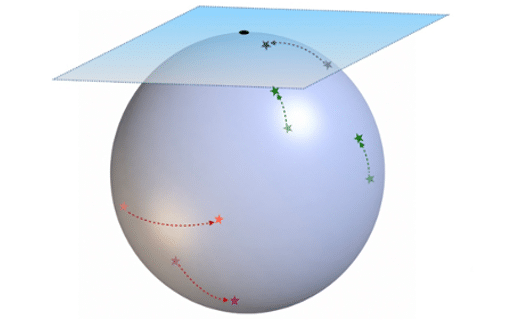
Le ciel de la lumière quantique n’est pas plat
Dans un travail récent, des chercheurs de l’équipe QITE du laboratoire MPQ et du département de mathématiques de l’ENS précisent le cadre mathématique pertinent pour décrire de façon cohérente les états quantiques impliquant plusieurs photons. (Gauche) Lorsque la...
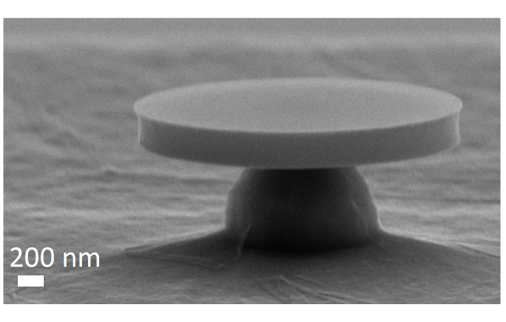
Un disque optomécanique dans son état fondamental de vibration
Le mouvement d’un résonateur mécanique d'échelle mésoscopique peut présenter un comportement quantique lorsque celui-ci est refroidi à de très basses températures. Il peut notamment atteindre son état fondamental et cesser de vibrer. En utilisant la lumière comme...
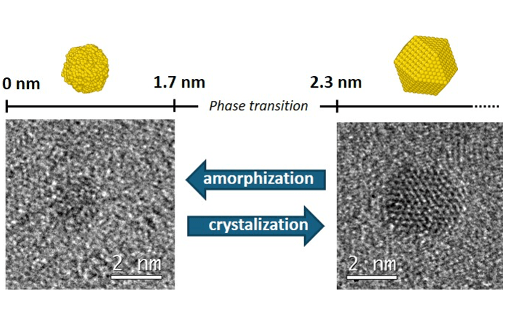
Observer l’or passer de l’ordre au désordre
Des chercheurs du laboratoire Matériaux et Phénomènes Quantiques ont observé pour la première fois une transition de phase réversible entre des états amorphes et cristallins dans des nanoparticules d'or de très petite taille. Leurs travaux montrent que la structure...