

The THEORIE group of MPQ laboratory is pioneering a new frontier of condensed matter physics: the control of electronic transport in cavity systems. The group has theoretically shown that the direct current (dc) magnetotransport of a 2D electron gas can be strongly modified when inserted in an electromagnetic cavity resonator even in the absence of illumination.
A work in collaboration with experimental colleagues at ETHZ has just been published in Nature Physics and a detailed theoretical article appeared in Phys. Rev. B a few weeks earlier.
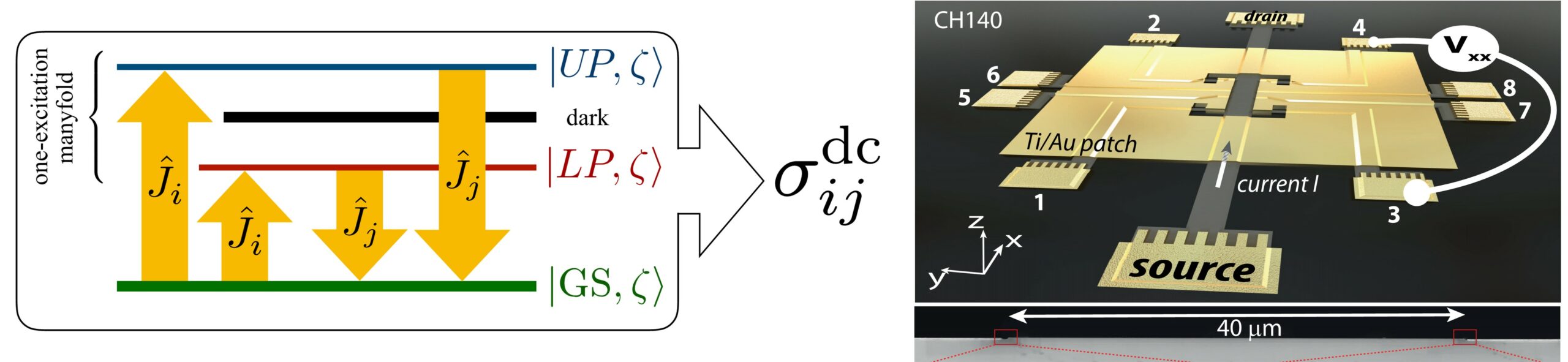
Left: the electron conductivity tensor is controlled by virtual excitation processes involving cavity polaritons. The linear response conductivity is modified even in the absence of illumination.
Right: a sketch of the sample measured in the magnetotransport experiments at ETHZ, an Hall bar inserted in a THz electromagnetic resonator.
Contact:
Cristiano Ciuti (cristiano.ciuti@univ-paris-diderot.fr)
References:
Vacuum-dressed cavity magnetotransport of a two-dimensional electron gas,
Nicola Bartolo and Cristiano Ciuti, Phys. Rev. B 98, 205301 (2018).
Magneto-transport controlled by Landau polariton states, Gian L. Paravicini-Bagliani, Felice Appugliese, Eli Richter, Federico Valmorra, Janine Keller, Mattias Beck, Nicola Bartolo, Clemens Rössler, Thomas Ihn, Klaus Ensslin, Cristiano Ciuti, Giacomo Scalari and Jérôme Faist, Nature Physics 1745-2481 (2018).
À lire aussi
Exact low-energy duality in superconducting quantum circuits
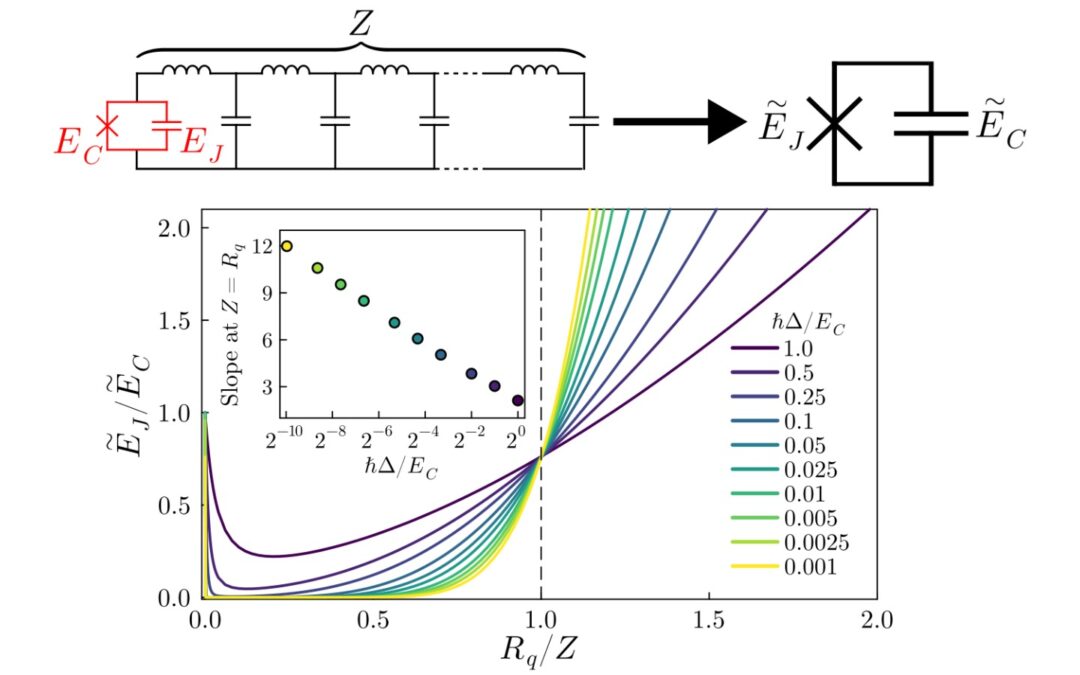
The THEORIE team, in collaboration with Michel H. Devoret, has published a theoretical study in Physical Review Letters demonstrating an exact low-energy duality in circuits where a Josephson junction is coupled to a multi-mode environment. These systems exhibit a...
Emergent Equilibrium in All-Optical Single Quantum-Trajectory Ising Machines
A collaboration between the Theory group at MPQ, CREF Rome, and Sapienza University of Rome has shown that multimode all-optical systems driven by two-photon processes can reach thermal equilibrium at the level of single quantum trajectories. The study is published in...
Cavity-enhanced fractional quantum Hall phases and cavity-modified spin splittings
A collaboration between the Equipe Théorie at MPQ and scientists from ETH Zurich and the Flatiron Institute has demonstrated, both theoretically and experimentally, that giant vacuum fields confined in a split-ring resonator cavity can profoundly alter...
Emergent quantum phase transition in superconducting circuits
The THEORIE team has recently published a significant theoretical study in Nature Communications on the topic of quantum critical phenomena. This research addresses a current debate that questions the traditional understanding of dissipative quantum phase transitions...